Why Your Breaker Trips Instantly (Even After Replacement)
Breaker trips instantly even after you replace it? Learn how dead shorts work, why new breakers don’t fix wiring faults, and when it’s time to call an electrician.
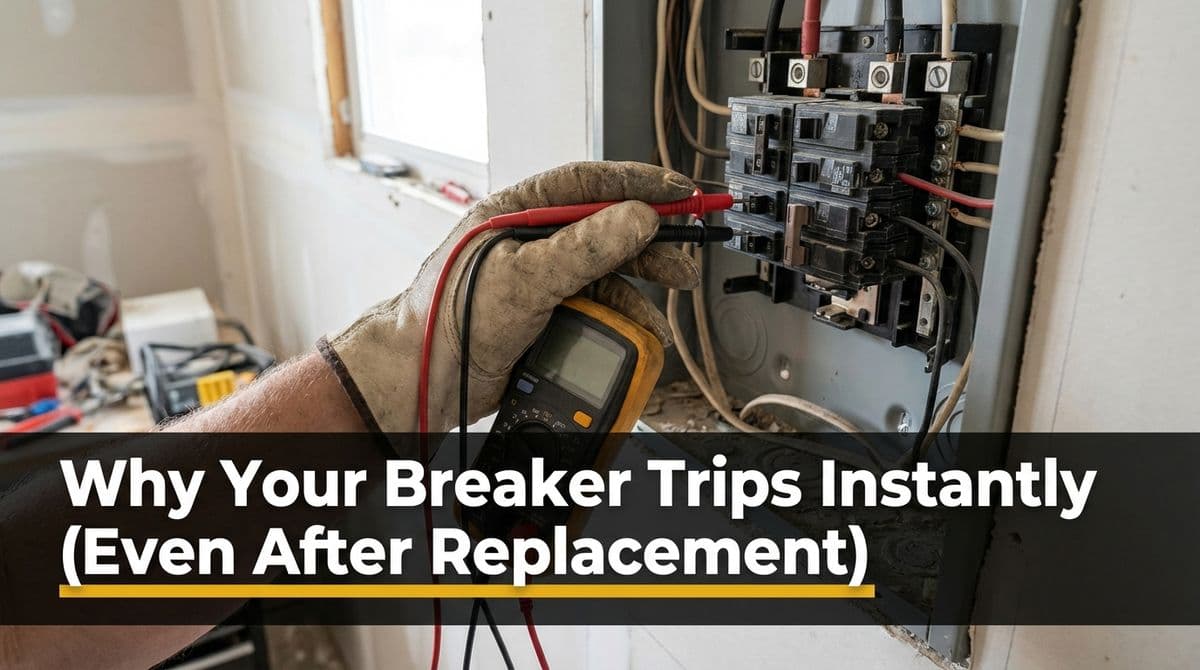
“My Breaker Pops Right Back Off” – What’s Really Going On
We recently got a call from a homeowner – let’s call him Mike – who was dealing with a really frustrating electrical problem.
Mike told us, “Every time I try to turn this breaker back on, it pops right out again. I even replaced the breaker, and the new one does the exact same thing.” The circuit fed his basement, main-floor bathroom light, an outside light by the door, and an exterior outlet – all dead.
He’d done what a lot of handy homeowners do: assumed the breaker was worn out, swapped it for a new one, and expected that to solve it. When it didn’t, he started to suspect a dead short and called us to diagnose it.
If this sounds familiar, you’re not alone. Let’s walk through what’s happening when a breaker trips instantly, why replacing it usually doesn’t help, and when it’s time to bring in an electrician.
What It Means When a Breaker Trips Instantly
There are a few different ways a breaker can misbehave, and they tell very different stories:
- Trips after a while – Often an overload (too many things on one circuit).
- Trips randomly – Could be a loose connection, failing device, or arc fault issue.
- Trips immediately when you flip it on – That’s the big red flag for a short circuit.
In Mike’s case, the breaker didn’t hesitate – the handle snapped back to “off” the split second he tried to reset it. That behavior is typical of what many homeowners call a dead short: the hot (live) conductor is coming into direct contact with neutral or ground somewhere on that circuit.
When that happens, you don’t just have “too much load.” You’ve basically created a low-resistance path that lets a huge amount of current try to flow all at once. The breaker sees that surge and trips nearly instantaneously to keep the wiring from overheating or starting a fire.
Why Swapping the Breaker Rarely Fixes a Short
Mike had already tried the most common DIY move: “We took the breaker out and installed a new one, and it did the same thing. So it wasn’t the breaker causing the problem.” He was exactly right.
Standard breakers are pretty simple devices. They’re either:
- Thermal-magnetic breakers that trip from heat (overload) or strong magnetic pull (short circuit).
- Or specialty types like GFCI and arc-fault that sense additional conditions.
If a regular breaker trips instantly, you can replace it with the fanciest brand-new breaker on the shelf and it will do the same thing. The breaker is reacting to a fault in the wiring or connected equipment, not in itself.
That’s why we always caution homeowners: if the breaker trips immediately and a replacement does the same, stop there. Forcing the breaker on, upsizing it to a larger amp rating, or bypassing it is extremely dangerous. The breaker is the only thing standing between that short and a potential fire.
How Electricians Track Down a “Dead Short”
When our electricians arrive on a call like Mike’s, we approach it systematically. Here’s the basic process (simplified) so you understand what’s going on behind the scenes:
- Confirm the behavior at the panel
We identify the exact breaker and verify that it trips instantly when switched on. We also check whether it’s a standard, GFCI, or arc-fault breaker, since those can trip for different reasons. - Isolate the circuit
We’ll turn the breaker off and open up the panel to inspect the connection: look for loose wires, damaged insulation, or obvious shorts at the breaker itself or bus bar. - Disconnect loads to narrow it down
On a multi-stop circuit like Mike’s (basement, bathroom, outdoor light, exterior receptacle), we systematically disconnect sections – outlets, lights, switches – then attempt to re-energize the circuit.- If the breaker stays on with certain wires disconnected, we know the short is downstream.
- If it still trips instantly, the problem may be in the home-run cable or panel connection.
- Inspect boxes and devices
We open each junction box, light, and receptacle on that run looking for signs like burnt insulation, melted wire nuts, loose copper strands, or a screw that’s nicked a cable. - Test and repair
Once we find the fault – a damaged cable, corroded exterior outlet, water in a box, etc. – we repair or replace the affected wiring and retest the circuit with the breaker back in place.
This kind of troubleshooting takes time and experience. The short may not be where you’d expect; on Mike’s circuit, for example, the fact that the basement, bathroom, and outdoor points were all out told us they shared a common run, but not where along that run the problem lived.
Why Bathroom and Outdoor Circuits Deserve Extra Caution
One detail from Mike’s call jumped out at us: the problem areas were a bathroom light, basement, outside light, and exterior receptacle. Those are all high-moisture or semi-exposed locations.
In spots like these, we frequently find issues such as:
- Water intrusion in an exterior box or fixture.
- Corroded or loose connections in outdoor receptacles.
- Rodent damage to basement or exterior wall wiring.
- DIY additions tied into an existing bathroom or basement circuit.
Moisture and corrosion can create a path between hot and ground or neutral, effectively causing a short. Outdoors, a cracked fixture or failed in-use cover can let rain and snow in; in basements, it might be a damp, unfinished ceiling cavity where wires were never properly protected.
When You Can Troubleshoot – and When to Call Us
There are a couple of safe checks a homeowner can do with the breaker off:
- Visually inspect accessible outlets and switches on that circuit for burn marks or melted plastic.
- Unplug everything from the affected outlets, then try turning the breaker back on.
- If you know which light or outlet was last worked on, don’t use it until it’s inspected.
But if the breaker still trips instantly after you’ve unplugged everything, it’s time to pause. At that point, the problem is likely in the wiring or devices themselves, not something you can safely resolve without training.
Here’s a simple rule of thumb:
- If resetting the breaker causes an immediate trip – especially after replacing it – call an electrician.
- If the circuit feeds bathrooms, kitchens, basements, or the outdoors, treat it as a priority. Those areas mix electricity with water and people.
Need Help with a Stubborn Breaker? We’re Here.
Mike and his family were able to “work around” their dead circuit for a while with alternative lighting, but he knew that mystery short wasn’t going to fix itself. By the time we showed up for his morning appointment, he was mainly interested in one thing: “I just want to find out what that short is all about.”
That’s exactly what we do on calls like this: track down the fault, repair it correctly, and make sure the circuit is safe and compliant before we leave. If your breaker keeps tripping immediately – even after you’ve replaced it – don’t keep fighting with it or forcing it on.
Give us a call, let us do the diagnosing, and we’ll get your home back to safe, reliable power.